
Adam Back's Blockstream Borrows Billions, Hides CIO Chris Cook's Fraud Conviction. NYT Cheerleads while BSTR lists. Why?
Why is a man worth $78 billion borrowing half a billion dollars at 20%? A look at the Blockstream Mining Note (BMN), the mines we can't find, and the fraud convicted felon spending lavishly.

TLDR: Blockstream’s CEO, Adam Back, was just splashed across The New York Times as the most likely inventor of Bitcoin. Behind that halo, built by John Carreyrou at the NYT, Blockstream has quietly grown an investment product, the Blockstream Mining Note (BMN), from $200 million to $2 billion of issuance in just fourteen months.
The man actually running the mining operation that backs those notes is a convicted financial fraudster. His conviction appears nowhere in the offering documents. And he’s been spending money lavishly, buying jets, yachts, and penthouses.
Meanwhile, the Bitcoin mines that would have to exist to pay investors back don’t show up in a single public record we can find, or anywhere on the blockchain.
And now Adam Back is taking a company public on the NASDAQ and raising billions more from investors in America (via a SPAC). The new company, Bitcoin Standard Treasury Company (BSTR), is merging with Brandon Lutnick’s Cantor Equity Partners I in a deal anchored by a record $1.5 billion PIPE and more than 30,000 Bitcoin. It’s pitched as one of the largest publicly traded Bitcoin treasuries on Earth, just passed SEC review, and it’s expected to list by the end of this month.
This is all incredibly weird!
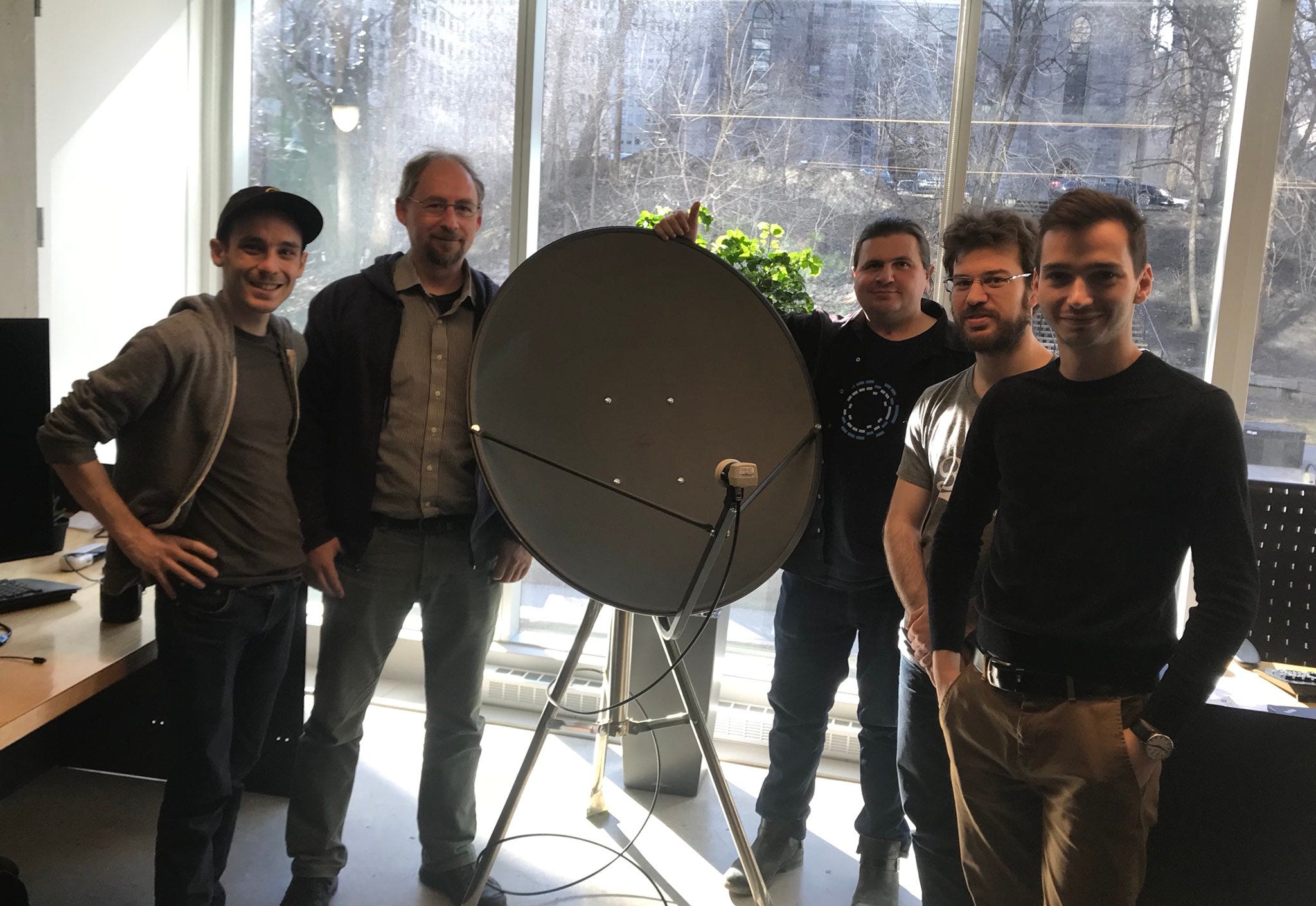
We think Blockstream is lying to investors and raising substantial sums of money. We have done a deep dive into Blockstream and related firms and the red flags are hard to ignore.
Blockstream talks a big game about Bitcoin but it’s not contributing much in terms of Bitcoin software. Blockstream’s reason for existence seems to be to raise money from investors by selling them an investment called the Blockstream Mining Note (BMN). In the last 14 months Blockstream has increased issuance of BMN from $200 million to $2 billion. There is no proof of Bitcoin reserves, there’s no independent custodian and no proof of scaling up Bitcoin mines. A related Adam Back vehicle, Bitcoin Standard Treasury Company (BSTR), is soon going to be listed on the NASDAQ raising billions more from the public. We are posting this as a warning as we think there’s substantial danger to the public just based on what’s already out there.
The CIO, Christopher William Cook, with a Fraud Conviction
The person actually running Blockstream’s mining operation is not Adam Back (although Back shills BMN as an investment a lot on social media). It is Christopher William Cook, listed before as Blockstream’s Chief Information Officer and currently the CEO of Exacore, the renamed/spun out Bitcoin mining division of Blockstream. Christopher William Cook was sentenced in 2008 by the United States District Court for the Southern District of Florida (Case No. 06-80187) to 41 months in federal prison for mail fraud, three years of supervised release, and $1,856,446.12 in restitution. Bureau of Prisons custody register number 75852-004. The fraud conviction was for borrowing money from vendors and doing a complex bust out scheme (Sopranos style!).

This conviction is not disclosed anywhere in the BMN offering documents. Investors handing over billions of dollars are not being told that one of the principal recipients of the funds being raised is a convicted financial fraudster.
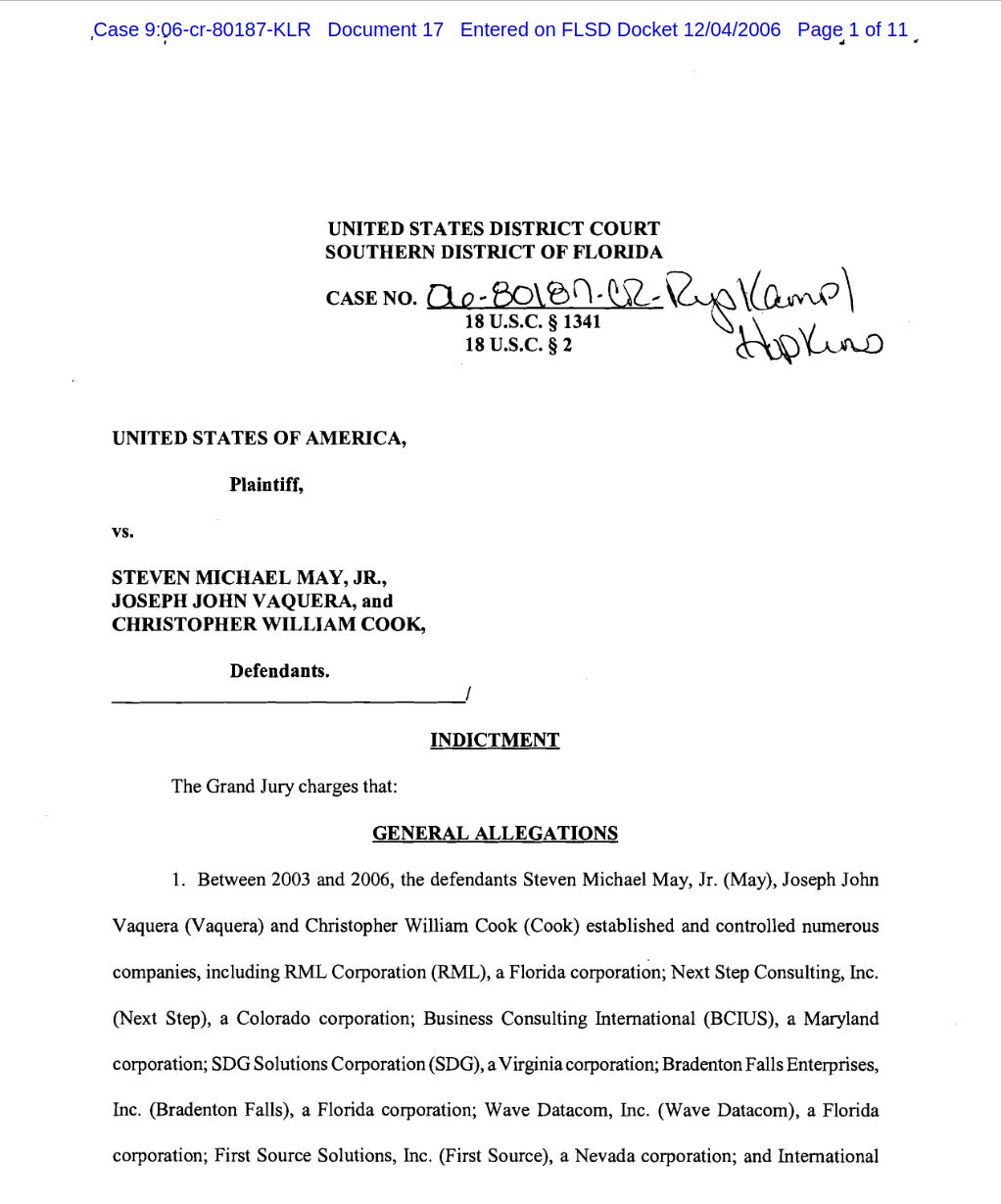
Here’s how the bust out scam Cook was involved in worked, according to the indictment:
The core mechanism was a business-to-business credit fraud. The three men (Chris Cook being 1/3rd of the trio) incorporated eight shell companies in different states and listed themselves - sometimes under fictitious names - as the officers. For each company they rented a “virtual office” in the state of incorporation, which bought them a local address, phone, and fax line so the businesses looked like real, operating firms even though most did little or no actual business. They then applied by email and fax for lines of credit with more than thirty retailers, propping up the applications with false financial statements and fake references. The trick that made it work was that the “trade references” were just other shell companies they controlled, and the “bank references” used real bank names but phone and fax numbers the defendants themselves answered - so when a retailer called to verify creditworthiness, one of the three was on the other end vouching for them. Once approved, they ordered high-end goods (flat-screen TVs, Apple computers, power tools, gift cards, camcorders) on credit, had them shipped to addresses they controlled, never paid the invoices, and resold the merchandise on eBay as “brand new, never opened.” In total they’re alleged to have taken in more than $1.8 million in goods from over 30 businesses.
Chris Cook focused on the Next Step and Wave Datacom side. He leased the virtual offices for Next Step in Denver and Wave Datacom in West Palm Beach, and he rented a commercial mailbox on Lakeview Avenue in West Palm Beach that received Next Step shipments - including goods re-shipped down from the Denver office, which showcases the layering they used to cover their tracks and delay getting busted. The very first charged shipment, the video projectors, was addressed to “Chris Cook” at Wave Datacom.
Cook makes extensive use of virtual offices to this day…
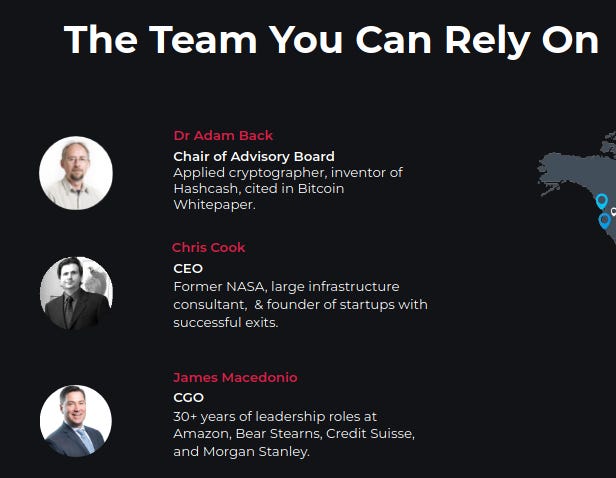
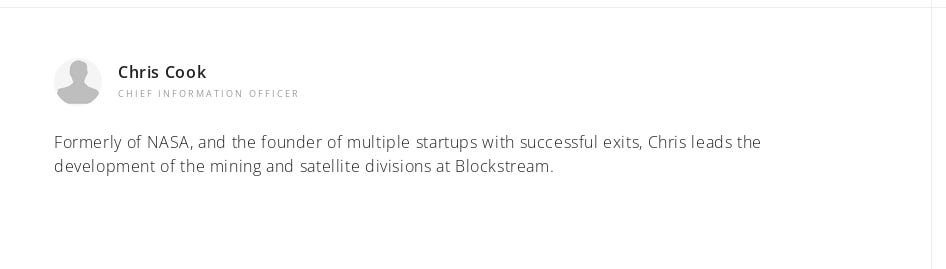
But it gets worse. Blockstream’s own marketing materials on the STOKR platform (the platform based in Luxembourg used to issue billions in these suspect notes) have claimed Cook is, “former NASA” and “formerly of NASA.” Cook did not work at NASA! Based on his own resume, his NASA association was a school program that allowed him to visit NASA when he was 18 years old in 1999. Using a fabricated NASA affiliation to raise investor money is, by itself, securities fraud in our opinion.
Bitcoin Mines That Don’t Seem To Exist (At Scale!)
Here is the core problem with BMN. The notes are sold as a claim on Bitcoin mining. To pay back what Blockstream has promised investors over $1.5 billion in outstanding BMN obligations, the company would need to operate 20 exahash+ per second of mining capacity, rising to about 35-45 exahash once the contractual cushion in the Terms and Conditions is included. Blockstream’s own dashboard only shows mining capacity of 15 exahash per second. This is a serious discrepancy! In plain English their mines can’t possibly produce enough Bitcoin to pay back all the investors (based on their own terms).
An operation at that scale would place Blockstream Mining/Exacore among the top five Bitcoin miners on Earth, in the same league as CleanSpark, Core Scientific, and Riot Platforms.
A Bitcoin mining operation of this size simply can’t be hidden. It appears in ERCOT interconnection filings in Texas. It appears in Hydro-Québec power purchase agreements. It appears in customs import declarations for ASIC hardware. It appears in county property tax rolls. It appears in mining pool hashrate attribution (Blockstream claims it directs its hashrate at Slush Pool, which is now called Braiins). It appears in on-chain coinbase signatures (not Coinbase the company) from blocks the miners have mined.
None of that footprint exists for Blockstream! If Blockstream is a top 5 global miner why is there no evidence to prove this?
There are really only two explanations given what’s been laid out here… Either Blockstream is running one of the largest Bitcoin mining operations on Earth in total secret, invisible to every public registry, customs database, grid operator, and on-chain analyst, or the mining was never there to pay back what investors are owed, and the Bitcoin has to come from somewhere else.
Paying earlier investors with money from later investors is the textbook definition of a Ponzi, and as you’ll see, the offering documents spell out exactly how Blockstream is allowed to pay old investors with money from new investors.
The Contract Allows A Ponzi
Buried in Blockstream’s BMN2 Terms and Conditions is a clause called Substitute Performance BTC. It allows BMN Operations to satisfy its delivery obligation by handing over Bitcoin from any source whatsoever, at its sole discretion, at any point during the 48-month contract term. No notice required. No disclosure obligation. No cap on how much of the contract can be satisfied this way. This means while investors expect freshly mined bitcoin from Blockstream’s mining operation, Blockstream’s terms documents state that investors can be paid with any Bitcoin that comes from anywhere.
In plain language: the Bitcoin you receive at maturity does not have to come from mining. It can come from money paid in by the next round of investors. Blockstream has already publicly admitted doing exactly this with the predecessor product, BMN1. According to Hashrate Index, Blockstream “employed a supplemental top-up strategy, by purchasing the exact amount of BTC on the open market” to ensure investors in earlier tranches received what they were promised. We don’t think this is what investors signed up for.
Section 4.7 of the BMN2 Terms goes further. “BMN Operations may at its own discretion, invest or otherwise utilize the Available Capital.” There is no investment policy, no list of permitted uses, no segregation requirement, no reporting obligation, and no cap. The funds raised are placed into what the document itself describes as “an early stage company whose long-term prospects are uncertain,” (Exacore run by Christopher “Chris” Cook) with effectively unlimited discretion over how they are spent.
Where The Money Might Be Going
In the last three years, we believe Christopher Cook has personally spent almost half a billion dollars on penthouses, planes, yachts, and more (with tens of millions of dollars going to Trump related entities). In December 2025 Cook paid nearly $29 million for a Penthouse at the UN Plaza in Manhattan. He owns two private planes, a Gulfstream G650ER and a Boeing 767 and has long term leased a third jet, a Gulfstream G550. He owns at least thirty separate apartments/units in the Bentley Bay development in Miami Beach. He bought a Las Vegas mansion formerly owned by Michael Jackson for $15 million. He paid over $15 million for an Orlando resort home. And Cook spent another $15 million on a Maui property that’s over 70 acres. He bid over $2.8 million on movie memorabilia at a London auction in December 2025 (he was sued for not paying the bill for this).
Are you a journalist who wants more info on this? Please reach out to me via email nat@natinfosec.com, I am happy to share my research.
That is not the only unpaid bill. Distributed Power Solutions sued Exacore — the company Chris Cook leads as CEO, Blockstream's bitcoin mining operations — in Harris County, Texas, seeking roughly $1.7 million for unpaid generator rentals and pass-through fuel costs at the Iraan, Texas mining site. The case was later resolved through a settlement signed on Exacore's behalf by Cook. The pattern appears to extend to his other entities: Sunbelt Rentals sued Cook's Florida company Waterway Wireless over unpaid invoices for industrial generators delivered to Blockstream's mining facility in Adel, Georgia, and Enverus, a power analytics software company, has sued Cook’s company XCVR Corporation over unpaid fees for grid-pricing software used in mining site scouting. Taken together, it's an unusual pattern.
Cook has long owned a Florida company nominally offering WiFi to folks in Florida called Waterway Wireless. That company has no operational use for industrial generators. Yet it rented thirty-two 600-volt generator packages and had them delivered to Blockstream’s mining site in Adel Georgia, on credit. This is the classic structure of procurement fraud: insert a personally controlled vendor between the company (Blockstream) and the actual supplier (Sunbelt Rentals), mark up the invoice, capture the spread. In this case Cook’s company Waterway Wireless did not even pay the supplier. Sunbelt Rentals (the company that leased the generators) had to sue to recover the money for equipment that had already been deployed at Blockstream’s mining site.

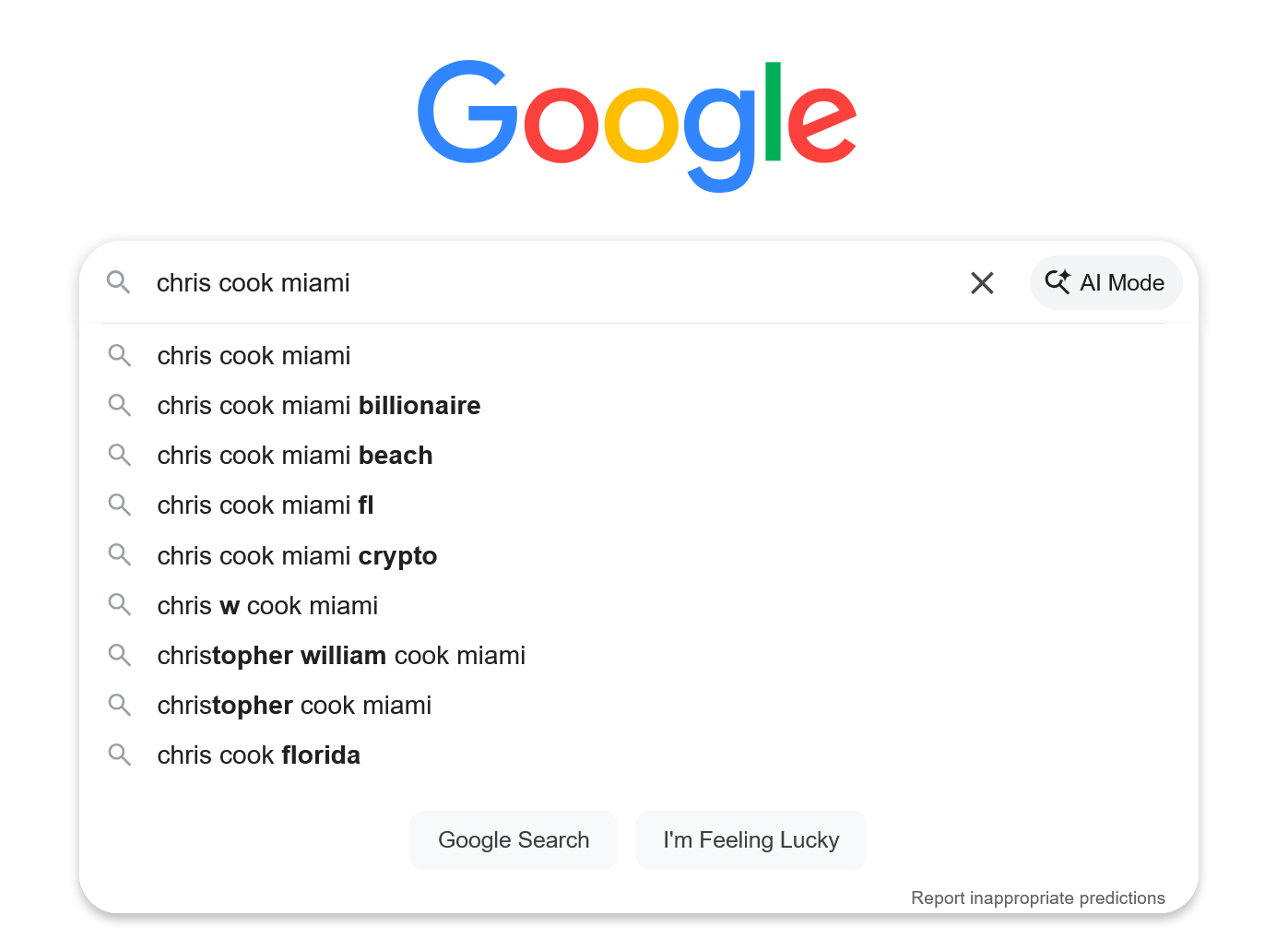
Cook bought a 136-foot yacht named DEFIANT that we believe cost over $12 million. He also has a car collection that ranges from Lamborghinis and several Ferraris to an Aston Martin and DeLoreans. The spending is unlike anything we've seen before (which is saying something).
Trump Media Investment
In July 2024, Cook attended a closed-door round table with then-candidate Donald Trump at the Bitcoin 2024 conference in Nashville, flying in on his private jet. He has since spent $12.4 million on an investment in Trump Media. Source: https://www.sec.gov/Archives/edgar/data/1849635/000114036125021579/ny20050075x1_s3.htm
Consists of 486,003 shares of Common Stock purchased in the PIPE Financing. Christopher Cook has voting and investment discretion with respect to the shares held by C Systems USA LLC. The business address of C Systems USA LLC is 1200 Brickell Ave, Suite 800, Miami, FL 33131.
Why is Adam Back Borrowing At Distressed Yields
Blockstream is offering higher and higher yields to investors. Well into distressed territory. Through STOKR, the same Luxembourg platform that issues BMN, Blockstream has issued three other tokenized notes layered on top of the mining structure. They are called PKB, PKH, and PKH2. Each one pays a fixed yearly interest. The interest rate has gone up each time. PKB pays 9.775% in Bitcoin. Then came PKH at 18%. That was then rolled over into PKH2 at 20% with $559.45 million outstanding! This is not normal.
Look at the trend. 9.775%, then 18%, then 20%. The cost of capital is doubling and then climbing again with each new rollover. And here is the part that should make every investor familiar with distressed debt sit up straight: when these notes “matured,” nothing actually got paid. They just got rolled into higher yielding notes (one could liken this to paying off one credit card with another, except a higher interest credit card is used).
A 20% fixed yield on a Bitcoin mining business should set off alarms by itself. Think about what that number means. Legitimate fixed-income products price off a risk-free rate plus a credit spread. With US Treasuries in the low single digits, a 20% coupon implies either extraordinary credit risk that the issuer is not pricing as such, or a business capable of consistently returning more than every asset class in modern finance. Bitcoin mining is neither. Mining margins are thin, brutally cyclical, and tied to a hashprice that just last month sat around $30-35, with breakeven for the average miner around $35. No mining operation on Earth can commit to a static 20% BTC-denominated return across a multi-year term because the underlying economics are not static. Hashprice fluctuates daily. Difficulty climbs constantly. Energy costs swing with grid conditions. Halvings cut block rewards in half every four years.
Here is the authorized issuance capacity, as disclosed in notifications from SICOS Securities, the Luxembourg management company that is closely connected to Blockstream.
In mid-July 2024 the cap was $200 million. On February 4, 2025 it was raised to $500 million. On April 17, 2025 it was raised to $1 billion. On October 1, 2025 it was raised to $2 billion. A tenfold expansion in fourteen months. Three doublings in eight months.
This is the cadence of an issuer racing to raise new capital quickly. No real business can scale infrastructure and build-out heavy business like this.
Conflicts Of Interest All Around
The BMN2 offering documents present SICOS Securities, the Luxembourg management company, and STOKR, the technology provider and marketplace, as independent service providers. They are not.
Arnab Naskar is a Manager of SICOS Securities and the co-founder and co-CEO of STOKR. Tobias Seidl is a Manager of SICOS Securities and the co-founder and co-CEO of STOKR. Milena Nikolova is Head of Compliance at STOKR and signed the BMN2 Specific Management Regulations as a Manager of SICOS Securities effective February 4, 2025. Surya Vajjhala is IT Manager at STOKR and concurrently a backend developer at SICOS. Travin Keith has written openly on social media that “STOKR was co-founded through the SICOS SCS partnership.”
And the lead investor in both is the same. Fulgur Ventures, managed by Vitaly Bezrodnykh in Italy and Oleg Mikhalsky in Boston, invested $210 million in Blockstream via a convertible note in October 2024 and is also the lead investor in STOKR through a $7.4 million stake. Mikhalsky personally holds more than 50 percent of the voting interest in Blockstream Capital Partners. Fulgur is also the lead investor in the BSTR-Cantor SPAC merger, subscribing for 2.5 million Class A shares, more than 12 percent of the deal.
None of these relationships is disclosed as a conflict of interest in the BMN investor disclosures. And they have not been mentioned in the BSTR disclosures either. The massive Bitcoin obligations Blockstream is carrying in the form of BMN’s we feel should be disclosed to BSTR investors!
L-BTC vs. BTC
You won’t even be paid in real Bitcoin if you invest in this! BMN investors aren’t paid back in Bitcoin. They’re paid in Liquid Bitcoin (L-BTC), a separate asset on a separate blockchain run by Blockstream and a small federation of partners. To turn L-BTC into actual BTC you have to “peg out” through that federation, which can decline the conversion at its discretion (yes, this is all disclosed!).
On the real Bitcoin blockchain, an analyst can trace whether a payout came from a freshly mined block or an exchange withdrawal. On Liquid, that trail breaks, outsiders can’t verify how much L-BTC is flowing from Blockstream’s wallets to investors. And in January 2026, the Mempool.space dashboard briefly showed L-BTC only 82.4% collateralized 3,463 actual Bitcoin backing 4,199 L-BTC in circulation before going blank with “Indexing in progress.” Adam Back quickly took to Twitter to blame outdated software.
NASDAQ Listing SPAC (BSTR)
Everything so far only mattered to rich private investors who wanted to take high risk generating yield from Bitcoin. But now Adam Back is listing a company on the NASDAQ along with Brandon Lutnick.
The BSTR structure is full of governance problems. No third-party fairness opinion was obtained, which is highly irregular for a deal of this size. Adam Back signed the contribution agreement for 25,000 Bitcoin on behalf of both the seller and the recipient. The post-merger custodian, Komainu, is 25 percent owned by Blockstream Capital Partners, with Back and other prospective Pubco directors on its board. The Christopher Cook fraud conviction does not appear in the registration filings (Blockstream has engineered this SPAC to keep the company out of the limelight, we’d say). Neither do the massive BMN obligations of Blockstream show up in the BSTR filings! Bad.
John Carreyrou and The New York Times Helping With Fund Raise
On April 8, 2026, John Carreyrou, the reporter who exposed Theranos, published an 18-month investigation in The New York Times concluding that Adam Back is the strongest candidate to be Satoshi Nakamoto. On the Times’ own podcast he put his confidence at 99.5%. The underlying case is almost entirely circumstantial: shared British spellings and hyphenation habits, two spaces between sentences, fluency in C++, AI-assisted stylometry run against several cypherpunk-era posters, and Carreyrou’s read of Back’s body language as “fishy.”
The NYT piece handed Blockstream an incredibly valuable marketing push, the suggestion that its CEO invented Bitcoin and sits on roughly 1.1 million BTC worth about $78 billion, stamped by one of the most credible investigative journalists in America.
The piece ran while Back’s BSTR’s merger with Cantor Equity Partners I (a record $1.5 billion PIPE, 30,000-plus BTC, pitched as one of the largest publicly traded Bitcoin treasuries on Earth) was pending SEC review (which cleared on Friday). It ran in the same window that Blockstream faced an unusual redemption it had to satisfy to the tune of over $400 million. A glowing Times feature by the world’s most famous fraud reporter is steroids for a fundraiser, and a useful brake on redemptions.
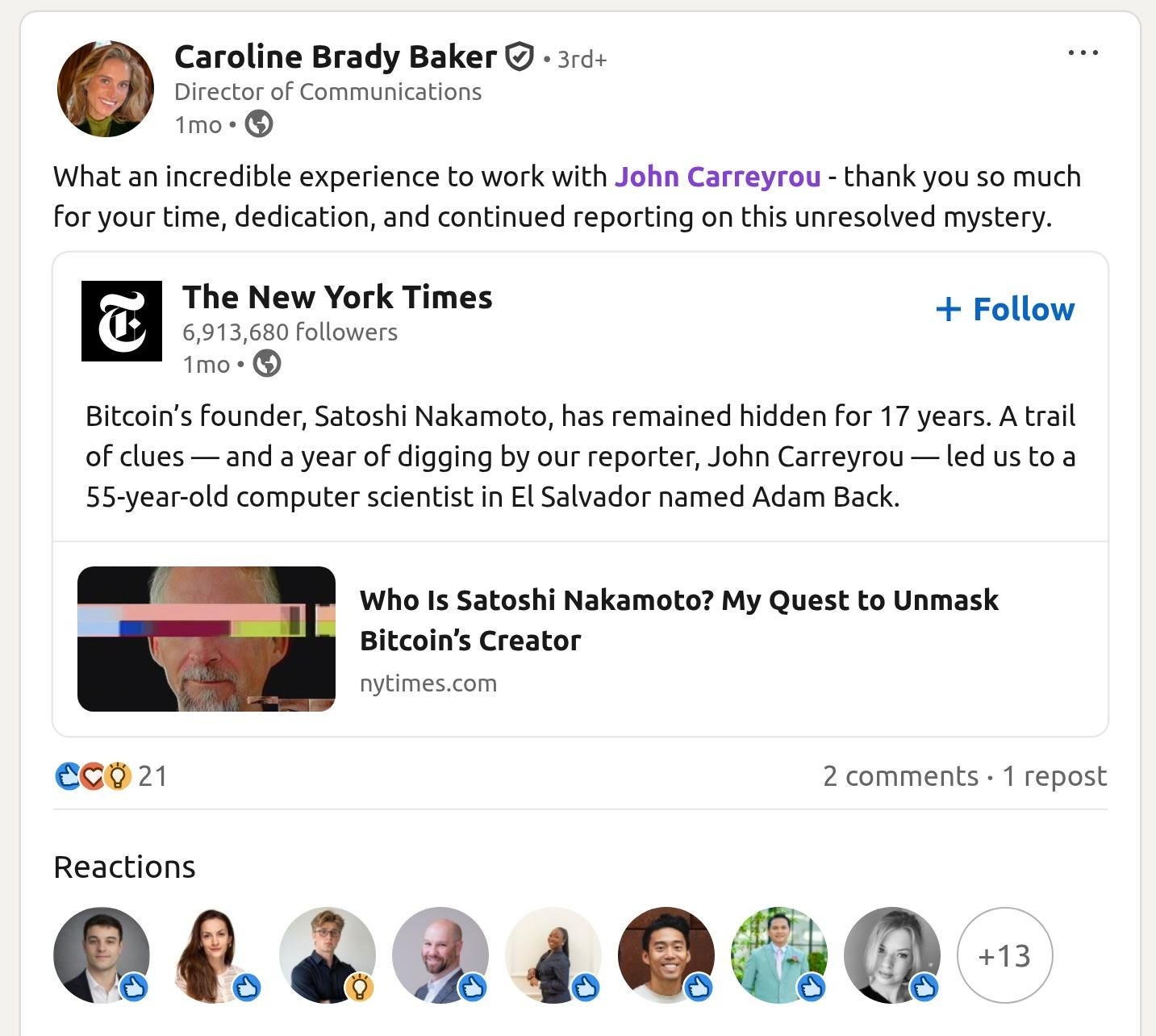
We are not the only ones who noticed. Multiple outlets framed the episode as a PR coup for Blockstream ahead of the BSTR listing. An analyst called it “pretty damn good PR” at a cost of roughly zero. Weeks before publication, Back agreed to pose for a Times photographer in Miami knowing the NYT feature would name him as Satoshi, and folks wondered why a man who is not Satoshi would sit for a photoshoot built around outing him as Satoshi. Stranger still, Blockstream’s own Director of Communications, Caroline Brady Baker, went on LinkedIn to call it “an incredible experience to work with John Carreyrou,” thanking him for his “continued reporting on this unresolved mystery.” Subjects of genuine investigations do not usually thank the reporter.
Several financial and tech outlets have walked through some of the facts. The “cryptographic technique” Satoshi “repurposed” was PGP, a tool half the internet uses. The C++ fluency points to one of the most widely used programming languages on Earth. As critics have pointed out, once an investigator narrows to a single suspect, confirmation bias does the rest — and a track record exposing corporate fraud doesn’t transfer to pseudonym-hunting. Much of the crypto community reached the same verdict, as evidenced by Polymarket odds of Adam Back being Satoshi staying below 7%.
The FT, looking at Adam Back, asked the obvious question: why would someone supposedly worth half a Warren Buffett (Hah!) be out financing multiple listed Bitcoin treasury companies, building an institutional-trading platform (or whatever Blockstream is), and steering a new Bitcoin treasury company toward a public listing that loads him with disclosure obligations? In the FT’s words, it is “a whole lot of hustle for not much relative gain.” Exactly! Why would a man sitting on roughly $78 billion go out and pay 20 percent APR to borrow half a billion dollars? The Satoshi theory and the fundraising by Blockstream (which is mostly done in public and can be verified from the copious documentation online) cannot both make sense.
Carreyrou and The NYT spent 18 months investigating Adam Back but failed to see the glaring red flags that actually threaten the investors lending money to Adam Back and his companies: the roughly $2 billion in BMN authorized obligations, most of it cash coming in the door and flowing straight to Christopher Cook; Cook’s undisclosed federal fraud conviction; his spending spree on multiple private jets, 30+ houses, yachts, and Trump Media stock; the mining footprint that doesn’t seem to exist at the required scale; the escalating-coupon refinancing Jenga tower; the conflicts running through SICOS, STOKR, and Fulgur Ventures; and the BSTR governance and custodial red flags (we believe Komainu is compromised). As Steven Levy at WIRED put it: somewhere, a company Carreyrou might have exposed as fraudulent has been spared his scrutiny…
The net effect of NYT’s actions has been incredibly damaging. One of the most famous fraud reporters alive lent his name to a PR puff piece that has measurably improved the fundraising prospects of an enterprise we believe is lying to raise money. The Times could spend a year and a half on Adam Back’s prose style and never once ask why Adam Back was raising money across half a dozen entities, or why a man supposedly with one of the largest fortunes on the planet borrows at distressed level yields. Always try to understand how someone is making money that’s a great way to understand incentives. As someone wise once said, “show me the incentive, and I’ll show you the outcome.”
This is part 1. We’ll be posting more information. We hope that the BSTR SPAC listing will be reviewed more closely given the red flags we’ve outlined here which were not listed in the SEC documentation.
Are you a journalist who wants to learn more about this? Please visit my website NatInfoSec.com and get in touch with me or email me at nat@natinfosec.com.